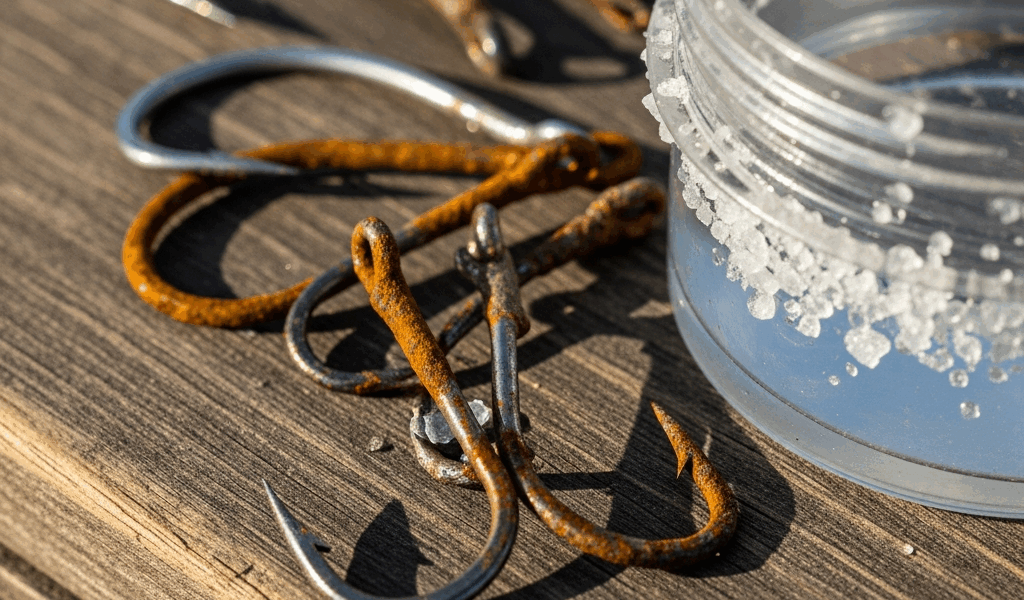
The Real Reason Hooks Rust Faster Than They Should
Hook rust has gotten complicated with all the bad advice flying around. Rinse them. Dry them. Store them properly. Sure — but if you’re already doing those things and still watching brand-new hooks turn orange between trips, the generic guidance isn’t solving your actual problem.
As someone who lost way too many good hooks to rust before figuring this out, I learned everything there is to know about what actually causes the damage. Today, I will share it all with you.
The short version: you’re probably dealing with three or four causes hitting at once. Moisture that wasn’t fully removed. Storage conditions that trap humidity. Sometimes the hooks themselves are made from alloys that oxidize fast by design. Not every angler gets hit by all three. But most of us? Guilty of at least two.
So, without further ado, let’s dive in.
Saltwater and Moisture Left on the Hook
Saltwater anglers have it worse — obviously. But freshwater fishing isn’t a free pass. Bait slime, fish slime, hard water minerals — they all leave a conductive film on the hook surface. That film speeds up oxidation. Then the hooks go into storage with even a trace of moisture still on them, and corrosion does its work in the dark for days.
Rinsing under tap water helps. Mostly. But what actually stops rust is wiping each hook dry with a cloth immediately after use. Not five minutes later. Not after you’ve packed the cooler and loaded the truck. Right then.
Probably should have opened with this section, honestly. I spent three seasons rinsing my Gamakatsu offset worm hooks in a bucket at the launch, patting them with a damp paper towel, and calling it done. Damp paper towel. I was putting water back on the hooks. By the time I got home — maybe forty-five minutes later — they’d been sitting in a damp tackle bag long enough for the process to start.
Don’t make my mistake. Grab a microfiber cloth or even an old cotton t-shirt. Wipe each hook dry. Get into the barb and around the eye. A dozen hooks takes ninety seconds. For saltwater trips specifically, rinse with freshwater first to knock off the salt, then wipe dry. That sequence alone stops maybe sixty percent of the problem.
How You Store Your Hooks Is Probably the Problem
This is where most anglers fail without realizing it. Sealed plastic tackle boxes with foam inserts seem like the obvious solution. They’re actually the enemy.
Foam holds moisture like a sponge. Plastic compartments seal in humidity. Even hooks that went into the box perfectly dry will find ambient moisture in that little microclimate — especially in a warm garage or a damp basement. You’ve essentially built a rust incubator and paid thirty bucks for it.
I had a Plano 3600 full of offset hooks — nice ones, cost me around thirty dollars for the batch. Stored it in my garage after a spring trip in April. Opened it in late May. The hooks looked like they’d been sitting in a puddle. The foam had held humidity against them for six weeks straight. That was 2019. I haven’t used foam inserts since.
The fixes aren’t expensive. Just different:
- Toss silica gel packs inside sealed boxes. A ten-pack runs about three dollars on Amazon. Replace them each season or after any humid trip.
- Store hooks in small kraft paper envelopes instead of sealed plastic compartments. Paper breathes. Moisture escapes. Simple.
- Leave the lid cracked or fully off your tackle box when storing at home. Sounds counterintuitive. Works well.
- Move your tackle out of the garage entirely if you’re in a humid climate. A dry closet indoors makes a measurable difference.
That’s what makes airflow endearing to us hook-obsessed anglers — it’s free, and it works better than anything you can buy.
Cheap Hook Alloys and When to Just Replace Them
But what is hook quality, really? In essence, it’s the combination of base metal and coating thickness. But it’s much more than that — it determines how fast your hooks fail regardless of everything else you do right.
Tin-coated hooks — common on budget brands from the bargain bins — oxidize fast. The coating is thin, and tin itself isn’t particularly rust-resistant. Nickel-plated hooks hold up noticeably longer under the same conditions. Chemically sharpened hooks from Owner or Gamakatsu use higher-grade carbon steel with meaningfully better corrosion resistance.
I’m apparently a Gamakatsu person and the EWG Superline hooks work for me while the generic bulk packs from the discount aisle never lasted more than a season. The price difference sounds painful upfront. It isn’t over time.
Owner and Gamakatsu hooks in sizes 1/0 through 5/0 run roughly four to six cents per hook. The bargain options cost maybe two or three cents each — but you’re replacing them twice as often, sometimes more. A fifty-pack of quality hooks at eight dollars beats replacing a hundred cheap ones every season.
Check your packaging. If the brand doesn’t mention the coating type or alloy, assume it’s the cheapest available option. Upgrade accordingly.
How to Save Hooks That Have Already Started to Rust
Light surface rust — a thin orange film, nothing structural — is recoverable. Grab 0000 steel wool (the very fine stuff, not the coarse kitchen variety) and scrub gently under running water. Dry immediately with a cloth. The oxidation comes off without wrecking the point.
Deep pitting is a different story. Actual holes or craters in the metal mean the hook is structurally compromised. It can bend or snap under load. Throw it away. A lost fish is annoying. A broken hook during a fight with something large is worse.
Frustrated by watching recovered hooks rust again within a few weeks, I started treating any cleaned hook with a light coat of reel oil — just a trace amount on a cloth, wiped across the surface. It creates a thin barrier and buys time. Not a permanent fix, but useful for hooks you’ve already rescued.
This new habit took hold several seasons later and eventually evolved into the full prevention routine enthusiasts know and rely on today: wipe dry immediately after use, store in vented containers with silica gel, and start with quality hooks that resist corrosion before you even factor in maintenance. Prevention beats recovery every single time.




Stay in the loop
Get the latest fish blog updates delivered to your inbox.