The Real Reason You Keep Snagging
Bass fishing has gotten complicated with all the gear advice and YouTube tutorials flying around. As someone who has lost probably $80 worth of crankbaits to a single rocky flat in one afternoon, I learned everything there is to know about snagging — the hard way. Today, I will share it all with you.
Here’s the thing most anglers miss: repeated snagging in a single session isn’t bad luck. It’s a pattern. And patterns have causes — usually three specific ones you’re getting wrong in real time, all fixable once you know what to look for.
You Are Fishing the Wrong Hook Setup for the Bottom
Probably should have opened with this section, honestly. This is the biggest culprit by a wide margin.
I learned this on a spring morning at a muddy reservoir outside of town — tied on a crankbait with exposed treble hooks, the kind that grabs everything including the lake floor, and spent two full hours yanking lures free instead of actually catching bass. Don’t make my mistake. The problem is simple: most anglers own one or two versatile setups and expect them to work everywhere. They don’t.
Rocky and Hard-Pan Bottoms
But what is a “snag-prone setup”? In essence, it’s any lure with exposed hook points meeting a bottom type that grabs them. But it’s much more than that — it’s also about the lure’s shape, weight, and how it moves through structure.
Rocky bottoms and firm clay are treble hook graveyards. The hooks find crevices like they’re magnetized. A compact lipless rattlebait — something like a 3/8-ounce Rat-L-Trap — rides shallow and bounces off hard surfaces instead of hanging up. Tighter trebles, smaller profile, same action. That’s what makes lipless crankbaits endearing to us structure fishermen.
Another option worth considering: a vibrating jig with a compact profile. Less hook exposure. Same triggering action. Genuinely underrated.
Grass and Vegetation
Exposed trebles are your enemy here — full stop. Every blade catches. Move to a Texas-rigged soft plastic, something like a 4-inch ribbon-tail worm on a 3/16-ounce bullet sinker, or a weedless chatterbait. The worm stays on top of the vegetation. The chatterbait’s wire frame deflects grass away from the hook point. Both glide through thick cover without the constant snagging frustration.
Timber and Laydown Country
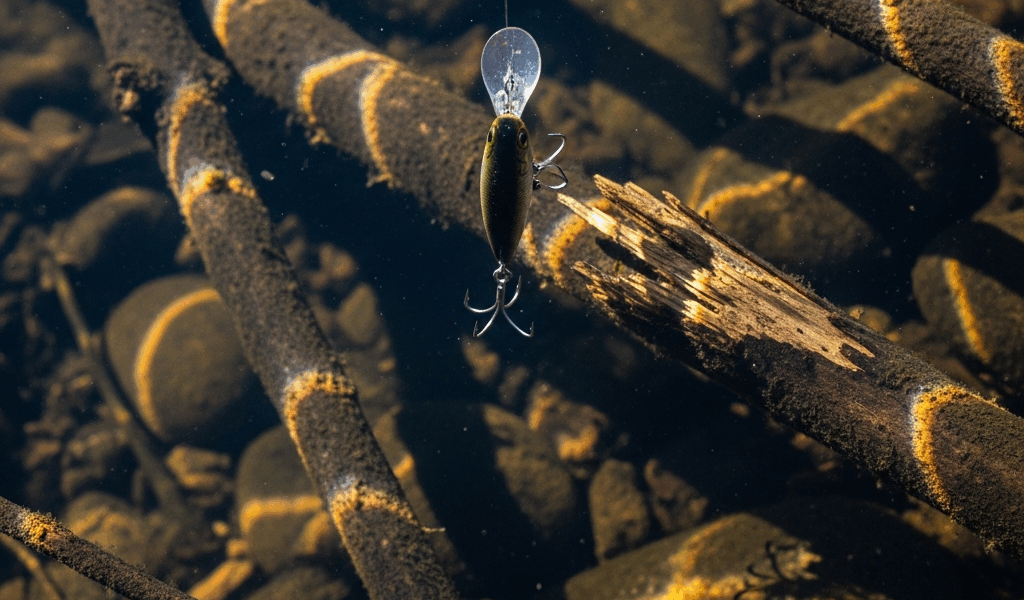
This is where a jig earns its paycheck. A 1/2-ounce jig with a 3-inch crawfish trailer flips into tight spots around deadfall with a single hook footprint — far smaller than a crankbait’s three exposed trebles. You’ll still catch wood occasionally. That’s timber fishing. But the difference in snag frequency is dramatic.
Open sand and silt bottoms? Now exposed trebles are completely fine. Standard crankbaits and spinnerbaits shine out there because there’s simply nothing to grab them.
Your Retrieve Is Pulling the Lure Straight Into Structure
Even the right lure snags constantly if you’re dragging it the wrong direction through the water column. A steady retrieve near timber pulls the lure directly into branches instead of over them. Same with a jig worked parallel to a laydown — wrong trajectory, wrong result. The lure’s path matters as much as the lure itself.
Lift-Pause-Drop Instead of Straight Dragging
Work a jig with a lift-pause-drop rhythm. Reel up two turns. Stop. Let it fall. Repeat. This keeps the lure from bulldozing into snags horizontally. The pause triggers strikes too — the lure looks wounded on the drop, which bass apparently find irresistible. I’m apparently a lift-pause guy and this technique works for me while straight dragging never does in heavy cover.
Counting Down to Find Your Depth Window
So, without further ado, let’s dive into the actual mechanics. Cast. Let the lure sink. Count: one one-thousand, two one-thousand, three one-thousand. Feel the bottom or vegetation contact. Start your retrieve from that depth. Adjust upward or downward based on where bites happen. This is how you avoid fishing in the thickest snag zone instead of just above it — which is where the fish usually are anyway.
Rod Angle Changes Everything
A crankbait fished with your rod tip at 9 o’clock dives and tracks on a steady horizontal plane. Move to 10 o’clock and reel slightly upward — now the lure rises as it moves forward, clearing shallower snags. Fishing near a laydown? Go to 11 o’clock. The lure rides high and skips over branches instead of digging underneath where it gets stuck every single cast.
How to Read the Bottom Before You Cast
Frustrated by wasted casts and lost lures, most anglers skip the scouting step entirely and just keep throwing money at the problem. Thirty seconds of bottom reading changes everything. This new habit took hold with serious tournament anglers several years ago and eventually evolved into the pre-cast diagnostic approach enthusiasts know and swear by today.
Drag a Weight to Feel Composition
Tie on a 1-ounce sinker. Cast near your intended zone. Drag it slowly across the bottom. Rocky feels sticky and resistant — almost grabby. Mud feels smooth, almost frictionless. Grass catches and releases rhythmically. After two or three drags you know exactly what’s down there. Switch lures accordingly. Takes maybe 90 seconds total.
Use a Float to Map Depth Changes
A slip bobber set at different depths tells you whether the bottom slopes gradually or drops sharply. Move the bobber stop up the line in 2-foot increments. Cast across the zone. If you hit bottom at 8 feet, then 6, then 4 feet moving toward shore — gentle slope, easier to navigate with the right retrieve angle. If you jump from 8 feet to 3 feet in one cast, there’s a drop-off with potentially steep rocks or deep timber right at that edge.
Polarized Glasses in Shallow Water
In water clearer than 3 feet, polarized sunglasses give you a visual map worth more than any casting experiment. I use Costa Del Mar 580G lenses — ran about $180 at the time, which felt like a lot until I stopped losing $14 crankbaits to rocks I could have just seen. Any quality polarized pair works. Look straight down. Individual rocks, logs, and grass clumps become visible. You’ll fish that water completely differently once you can actually see it.
Quick Fixes When You Are Already Snagging Mid-Session
You’re already frustrated. You don’t have time to retie or swap rod setups. Here are four adjustments you can make in seconds — no retracking required.
- Change rod angle. Raise your rod tip 18 inches higher than your current position. The lure rides higher in the water column, clearing snags that were grabbing it on the previous trajectory.
- Slow down. Cut retrieve speed in half. Slower movement gives the lure time to deflect off structure instead of plowing straight through it.
- Switch to weedless. If there’s a Texas-rigged plastic or weedless chatterbait anywhere in your tackle box — tie it on immediately. One hook always snags less than three. Always.
- Move two rod-lengths sideways. Fish a parallel path to the one that’s been snagging you. Same depth. Different trajectory. Sometimes that’s the entire fix.
The diagnostic mindset matters most here. Snags aren’t bad luck — they’re your lure sending information back up the line about what’s happening down there. Something needs to change each time: your presentation angle, your depth window, or your lure choice entirely. Start listening to what it’s telling you.
If snag prevention changes the hook, line, or lure you need, compare the complete system with our fishing gear checklist by water and technique.



Stay in the loop
Get the latest fish blog updates delivered to your inbox.