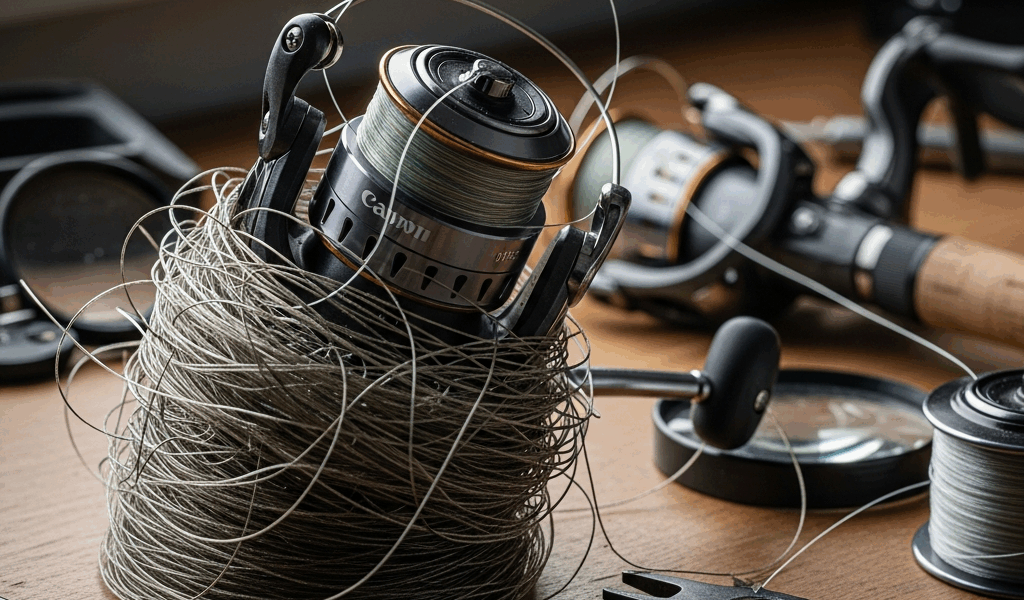
Why Your Line Twists in the First Place
Line twist has gotten complicated with all the conflicting advice flying around. As someone who spent an entire first summer fishing with what looked like a permanent bird’s nest attached to my spool, I learned everything there is to know about why this actually happens. Today, I will share it all with you.
The culprit is almost always one of three things. You spooled your reel backwards — and yes, that’s as simple and devastating as it sounds. The filler spool has a direction it needs to come off, and if it’s running opposite to your reel’s spool rotation, every single handle turn introduces new twist. Second thing: casting spinning lures without a swivel. A Rapala or small crankbait that rotates during retrieval torques your line like a drill bit. Third, and honestly the sneakiest one — reeling against a slipping drag. Your drag slips mid-cast, you keep cranking anyway, the spool rotates at a different speed than incoming line. Twist happens instantly. Every time.
Most generic advice skips straight past diagnosis and throws random fixes at you. Useless. So let’s figure out which problem is actually yours first.
How to Tell How Bad the Twist Actually Is
But what is line twist severity, really? In essence, it’s the difference between a 20-minute water fix and a full re-spool. But it’s much more than that — it tells you exactly where the damage lives.
Here’s the test. Cut off your lure. Let about three feet of line hang slack off your rod tip. Don’t touch anything. If it immediately coils on itself like a telephone cord, you have a real problem. If it hangs relatively straight, you’re probably dealing with minor spool-level twist that won’t kill your casting.
If the line spirals visibly, pull out another 10 feet and test again, higher up the spool. Twist getting worse near the reel? That’s a loading error — concentrated right at the source. Twist distributed throughout the whole line? That’s accumulated mechanical twist from casting or retrieve habits. Good news on that second one: the fix below was basically made for exactly that situation.
The test takes 30 seconds. Don’t skip it.
The Fast Fix That Works on the Water
Frustrated by constant tangles during a weekend trip to Seneca Lake in upstate New York, I picked up this fix from a local guide charging $300 a day — worth every penny, not even a question. He called it “straightening the line.” It works.
Let out 30 to 50 yards of line behind a moving boat. No lure attached. Just line trailing in water under zero tension. The moving water does the actual work, forcing the line to straighten under its own weight and mild water pressure. Reel back in slowly with light, even tension. That’s the whole thing.
Twist is stored energy — basically a coiled spring. Moving water lets that energy dissipate without generating new knots or kinks. You’re not fighting it. You’re letting it unwind on its own terms.
No boat? Walk a long straightaway with 50-plus yards of open space. A pier works. A parking lot edge works. Let the line trail behind you, then reel back in with steady, light pressure. Slower than the water method — maybe five minutes per 50 yards — but it absolutely works. You’ll actually feel the resistance change as twist comes out. That’s apparently my favorite part, and I’ve done this probably 40 times at this point.
This handles mild to moderate twist. Your casts will immediately feel cleaner afterward. Line memory noticeably drops.
How to Load Line Without Twisting It
Probably should have opened with this section, honestly. Prevention beats every cure here.
Spinning reels rotate the spool in one specific direction during retrieves. Your filler spool needs to come off in that exact same direction — full stop. Find the arrow printed on your filler spool cartridge. It shows which way line should peel off. Hold that cartridge so line comes off the top, moving in the same rotational direction your reel spool turns. Wrong direction? You’re building in twist before you’ve even made a single cast.
If you’re running a Shimano Sienna 2500 or a Pflueger President — both common beginner setups, both solid choices — watch your spool rotate as you crank the handle. Match that direction with your filler spool orientation. Simple check. Takes 10 seconds.
The pencil trick handles most of the remaining issues. Run a standard pencil or a wooden dowel through the center of your filler spool and have someone hold it loosely while you reel. It mimics the original spool resistance and keeps tension even throughout the load. Reel at a moderate, steady pace — not fast, not glacially slow, somewhere comfortable in the middle. Watch the line building on your reel. Smooth, even wraps are what you want. Loops or crisscrossing patterns mean you’re spooling too fast or your tension is off.
Load 100 to 150 yards depending on your reel capacity. Most 2500-size spinning reels take roughly 150 yards of 8-pound monofilament. Check your manual for exact numbers — I’m apparently meticulous about this and the Shimano manual works for me while guessing never does. Don’t make my mistake of skipping that step.
When to Just Cut Your Losses and Re-Spool
Sometimes the line is simply done. Twist that’s been sitting there for months creates permanent memory coils in monofilament — and you cannot unwind memory. It’s like trying to straighten a telephone cord that spent a year in a tight loop. It just wants to coil again. Always will.
Three signs it’s time for fresh line: it spirals off on its own with zero tension applied, you’ve run the straightening fix twice and twist returns within a day, or tangles keep happening at the exact same spot on your spool every cast. That spot has permanent damage. It’s not coming back.
Re-spooling takes 10 minutes and costs $8 to $12 at any big-box sporting goods store. That’s not a failure — that’s maintenance. A spool of Berkley Trilene XL runs about $10 and lasts months if you’re not grinding it against a slipping drag. Even experienced anglers re-spool two or three times per season. The line gets tired. That’s what happens.
That’s what makes fishing line endearing to us anglers, honestly — it’s consumable gear that actually tells you when it’s done. So, without further ado, once you’ve identified your specific cause — wrong spool direction, rotating lures, drag slippage — fix that first. Then decide: water pull-through, or fresh line with a proper load. One of those two options solves every version of this problem.


Stay in the loop
Get the latest fish blog updates delivered to your inbox.