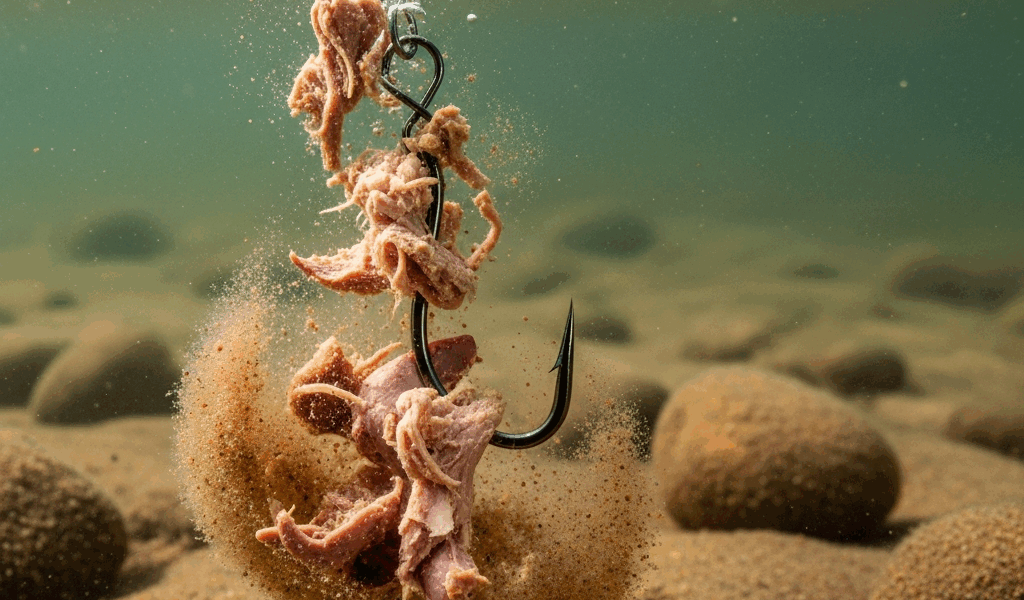
Why Soft Baits Keep Flying Off Your Hook
Catfishing has gotten complicated with all the conflicting advice flying around. As someone who has lost an embarrassing number of chicken livers to the river current, I learned everything there is to know about keeping soft bait on a hook. Today, I will share it all with you.
But what is bait loss, really? In essence, it’s a rigging failure. But it’s much more than that — it’s a mechanical mismatch between your setup and the forces working against you in the water.
Three forces are constantly destroying your presentation. Current pressure is the big one — a channel moving at 2+ mph creates lateral stress on whatever you’ve threaded onto that hook. Then there’s cast force. Your forward rod stroke generates serious acceleration, and soft baits can’t absorb that without proper anchoring. Last is hook gap mismatch. Too large a hook, and gravity drags the bait down the shank before it even hits the water.
Most anglers treat all baits identically. That’s the mistake. Chicken liver isn’t cut shad. Dough bait isn’t either. The rigging that saves one will absolutely fail the other. That’s what makes this problem so endearing to us catfishing folks — there’s no single fix, and figuring that out is half the battle. So, without further ado, let’s dive in.
Chicken Liver Keeps Flying Off — Here Is the Fix
Chicken liver is simultaneously the most popular catfish bait and the most commonly launched into the void on the forward cast. The tissue is genuinely fragile. Current doesn’t just wash it — it dismantles it, piece by piece.
The fix depends on how you want to approach it.
Thread Wrapping Method
Elastic bait thread — usually $3 to $5 per spool at any decent tackle shop — is your first line of defense. Wrap it around the hook eye, then cocoon the liver with five to eight passes around the bait itself. Tie it off clean. What this does is distribute pressure across the whole surface instead of letting it concentrate at one soft tear point. Honest caveat: this holds up to roughly 1.5 mph current. Push past that and you’re expecting too much from a spool of elastic.
Treble Hook Advantage
A size 2/0 or 3/0 treble hook changes the game entirely. Three points piercing liver at different angles beats one J-hook point every single time. One point slips. Three working together don’t. You give up a little sensitivity on the hook-set — fair trade in heavy current. I’m apparently a treble hook convert now, and a Mustad 3/0 works for me while standard J-hooks never hold liver past the first thirty seconds. Don’t make my mistake of waiting three seasons to switch.
Pantyhose Mesh Wrap
Cut a small square from a cheap pair of pantyhose — $1.50 at a dollar store, maybe less. Wrap the liver inside the mesh, secure everything to the hook with elastic thread. The mesh spreads surface area and stops the liver from compressing into that flat, current-vulnerable shape it naturally wants to become. Sounds absolutely ridiculous. Works better than most things that don’t sound ridiculous.
Cut Bait Sliding Down the Hook Shank
Probably should have opened with this section, honestly. Cut shad. Cut bluegill. Skipjack chunks. Anglers assume firmer bait means easier rigging. It doesn’t. A 3-inch cut shad slides down a hook shank in current just as fast as liver if it isn’t properly anchored — and this is where most bait-loss failures actually happen.
Hook Size Matching
A 3-inch cut shad needs a 4/0 or 5/0 hook. Not a 2/0. Not a 3/0. The gap has to sit tight against the bait body — if you can see open space between the bait and the hook eye after threading, you grabbed the wrong hook size. That bait is migrating down the shank the moment current touches it.
The Stitch Method
Experienced catfishermen know this one. Beginners almost never get taught it. Thread the hook through the bait at the head, then push it through the body again about an inch further back. Two penetration points instead of one. The bait physically cannot slide because it’s anchored at two separate locations along the shank. It looks strange on the hook. It holds in current above 2 mph where every other method starts failing.
Kahle Hook Over J-Hook
Kahle hooks might be the best option here, as cut bait requires a grip that a standard J-hook just doesn’t provide. That is because the Kahle’s wider gap and curved shank conform to irregular bait shapes naturally — a J-hook doesn’t. Size 3/0 to 4/0 Kahle hooks outperform J-hooks with cut bait, consistently. Same price per pack. Grab a few on your next tackle run and test them side by side. The difference shows up immediately.
Dough Bait and Stink Bait Falling Apart on the Cast
This problem splits depending on one variable most anglers completely ignore: bait temperature.
Warm Dough Bait
Warm or room-temperature dough compresses under casting force and comes apart. Full stop. While you won’t need a complete tackle overhaul, you will need a handful of sponge hooks — sizes 6 to 8 — or worm hooks with a wider gap. Sponge hooks absorb some of that casting G-force and distribute compression evenly across the bait. Thread the dough through the sponge, compress lightly, cast smoothly. Worm hooks — also called octopus hooks — work on the same principle because the wider gap creates more surface contact friction instead of relying on a single penetration point holding everything together.
Cold Dough Bait
Frustrated by watching warm dough explode off his hook mid-cast, a tournament catfisherman I met in Oklahoma started keeping his dough in a small cooler with an ice pack for two hours before fishing. That was the solution. Cold dough firms up to an almost clay-like consistency — a standard 2/0 or 3/0 J-hook holds it cleanly without any wrapping or mesh reinforcement. This new idea took off several years later and eventually evolved into the standard prep method serious catfishermen know and swear by today. The bait actually firms up further once it hits cool water. Free bonus.
Stink Bait Consistency
Commercial stink baits vary wildly. Some are paste-thick. Some are practically liquid — and liquid stink bait washes off before it reaches the bottom. You need paste consistency. I’m apparently a Secret-7 fan, and that brand works for me while thinner formulas never stay on past the first cast. If your stink bait runs too thin, mix in flour or crushed saltine crackers until it reaches a putty-like texture, then refrigerate it. Use sponge hooks or worm hooks — stink bait grips through adhesion and surface contact, not penetration, so the hook choice matters more than most people realize.
Quick Checklist Before You Cast Any Catfish Bait
- Hook size to bait ratio — Gap should sit tight against the bait. No visible space between hook eye and bait surface.
- Secure the bait before casting — Thread wrap, stitch method, or sponge hook. Gravity and friction alone are not a rigging strategy.
- Rod tip angle on the cast — Smooth, controlled motion only. Whipping or snapping the rod accelerates bait loss by roughly 40%. Cast like you mean it, not like you’re angry.
- Leader weight consideration — Heavier leaders slow bait movement through current. One to two ounces is the standard range for soft baits in moving water.
- Adjust for current speed — Slower current lets you rig lighter. Faster current demands thread wrapping, mesh reinforcement, or dual-point hook penetration — at least if you want the bait to survive the drift.
- Temperature matters — Cold dough is firm. Warm dough is a liability. Keep soft baits cool until the moment you cast.
Bait loss isn’t a mystery — it never was. It’s a rigging problem with specific, repeatable solutions. Match the method to the bait type, account for current speed and temperature, and the time you used to spend re-baiting every few minutes becomes time spent actually fighting fish.


Stay in the loop
Get the latest fish blog updates delivered to your inbox.