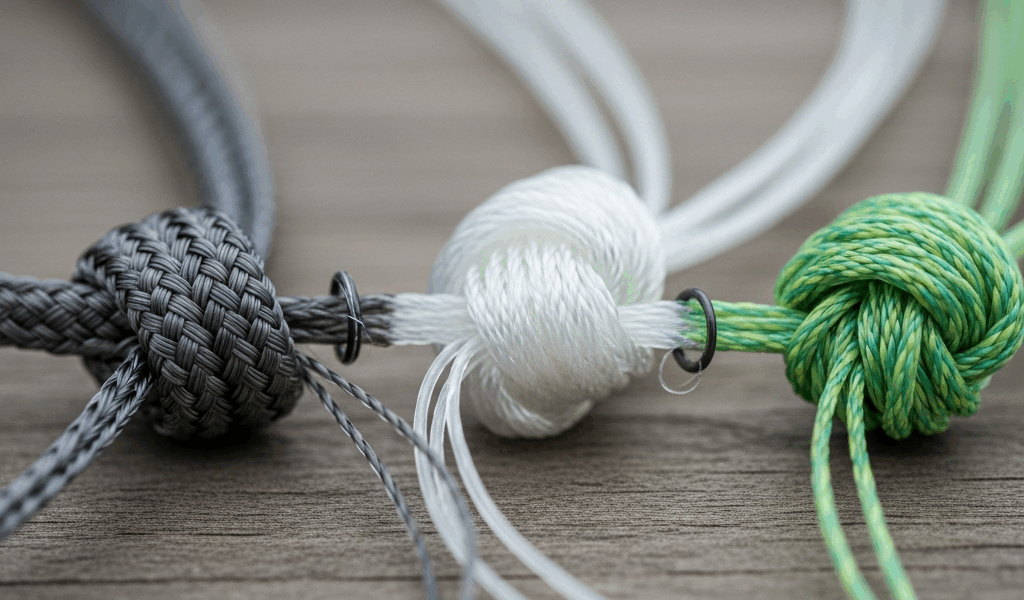
The Most Common Reason Knots Slip
Fishing knots have gotten complicated with all the conflicting advice flying around. But honestly? The number one reason your knot keeps slipping is embarrassingly simple: you tied it dry. That’s it. I’d wager that single mistake accounts for 70 percent of the frustration I see out on the water.
Here’s what actually happens. Cinch a knot without wetting it first and friction generates heat — enough heat to soften monofilament or fluorocarbon just slightly. The line starts compressing and sliding under load instead of locking. It doesn’t break clean. It creeps. Millimeter by millimeter until your lure is somewhere at the bottom of the lake.
Braid is a different animal entirely — more on that in a moment. But with mono and fluoro, water does two things: lubricates the tying process and dissipates heat during the cinch. Skip it and you’re essentially welding the knot shut with friction burn. The line goes brittle. It creeps under pressure. You lose fish.
Probably should have opened with this section, honestly. I learned it the hard way after losing a custom swimbait — $22, discontinued colorway — and spending twenty minutes backtracking only to find my Improved Clinch had migrated five feet down the line. Now I wet every knot without thinking. Five seconds. Costs nothing. Don’t make my mistake.
How Line Type Changes Everything
The same knot tied on monofilament will behave completely differently on braid. This is where most generic knot guides fall apart — they walk you through the hand movements and completely ignore the material you’re actually working with.
Monofilament — The Forgiving Standard
Mono is forgiving. It has natural grip, compresses predictably, and plays well with traditional knots like the Improved Clinch. I’m apparently a Berkley Trilene XL guy and it works for me while the generic discount-bin stuff never quite feels the same — but honestly, the physics holds up across brands. Wet it, cinch slowly, and mono will hold.
The weak point? UV degradation and abrasion wear it down faster than you’d expect. A slipping mono knot almost always traces back to skipping the water step or trimming the tag end so short there’s nothing left to anchor the wrap.
Fluorocarbon — Stiff and Unforgiving
Fluorocarbon is stiffer than mono. Much stiffer. It doesn’t compress into a knot shape readily, which means you can tie an Improved Clinch that looks textbook-perfect and still watch it slip the moment a bass hits hard. The line never actually seats into a locked configuration.
With fluoro, you need extra wraps — seven or eight instead of five or six. You also need to seat the knot with intention. Pull the tag end while holding steady pressure on the main line for a full three seconds. Watch it tighten gradually. Don’t yank it. The stiffness fights you at first, but patience builds a more reliable lock than rushing ever will.
Braided Line — Completely Different Rules
Braid is where anglers fail catastrophically. The individual strands have almost no friction against each other — that’s what makes braid so sensitive to wind knots, so dangerous when it wraps your hand, and so completely hostile to standard knot designs. An Improved Clinch that holds beautifully on mono will slide off braid like it was never there.
You need a knot built for braid’s specific properties. The Palomar outperforms nearly everything else because it uses a doubled-line bite — mechanical grip, not friction. If you absolutely insist on the Improved Clinch for braid, plan on eight to ten wraps instead of five. Even then, it’s unreliable. That’s not a knock on your technique. That’s just physics.
I switched to exclusively using the Palomar for any braided setup about three years ago. Lost two expensive swimbaits in one afternoon — same day, same stretch of water — and that was enough. The Palomar takes maybe fifteen extra seconds to tie. It has never slipped since.
Mistakes That Cause Slippage After the Knot Is Tied
Sometimes the knot fails after the cast is already in the air. These post-tying errors are completely preventable once you know what to look for.
The Tag End Is Too Short
Trim your tag end to exactly one-eighth inch. Not shorter. I watch anglers clip the line flush against the knot — thinking it looks cleaner, neater — and then stare at their empty hook wondering what happened. That tiny remaining tail is actually what keeps the knot locked. No tail, no mechanical grip. Simple as that.
You Loaded the Knot Before It Was Fully Seated
This one is subtle. You tie the knot, trim it, cast immediately. The problem is the knot wasn’t fully tightened yet. A proper cinch means pulling hard on both the main line and tag end for a solid two to three seconds after the knot shape forms — not a quick half-cinch and a hopeful cast. The knot tightens further under real load, which means it’s still settling during your cast instead of before it. That window is when slippage happens.
The Knot Received a Shock Load Instead of Steady Pressure
A slipped knot looks different from a broken one — and the difference tells you exactly what went wrong. A clean break leaves a sharp edge where the line parted. A slipped knot shows a loose wrap that migrated. The tag end might still be fully attached while the main line slid through the wraps entirely. This usually happens on the first cast, when a fish hits before the knot has had any time to compress under normal conditions.
Which Knots Are Actually Slip-Resistant
So, without further ado, let’s dive in. Stop tying whatever knot your buddy showed you five years ago and use these instead.
Palomar for Braided Line
The Palomar might be the best option for braid, as braided line requires mechanical grip rather than friction-based tension. That is because braid’s individual strands simply don’t generate reliable friction against each other — and the Palomar’s doubled-line bite sidesteps that problem entirely. The knot feels awkward at first. After ten repetitions, it becomes automatic. Strength-wise, it holds around 95 percent of line strength consistently — better than the Improved Clinch by a meaningful margin.
Improved Clinch for Monofilament
Five or six wraps, wetted, slowly cinched. The wraps create friction-based grip that actually works on mono because mono compresses predictably. Follow the process and this knot is nearly bulletproof. Skip the water or rush the cinch and it fails almost immediately. The knot doesn’t forgive shortcuts — but it rewards the ones who don’t take them.
Double Uni for Line-to-Line Connections
Connecting braid to a fluorocarbon leader is the most common setup in saltwater fishing. The Double Uni outperforms everything else for this job. Two separate uni knots back-to-back create a mechanical lock that doesn’t care what material you’re working with. Works equally well across all line types. That’s what makes the Double Uni endearing to us saltwater anglers who are constantly switching between materials.
Quick Checklist Before Every Cast
- Wet the knot with saliva or water before cinching — non-negotiable
- Cinch slowly, maintaining steady pressure for three full seconds
- Trim the tag end to exactly one-eighth inch
- Tug test the connection with steady pressure — not a jerk, a gradual pull
- Use the right knot for your line type (Palomar for braid, Improved Clinch for mono, Double Uni for leader connections)
- If using fluorocarbon, add two extra wraps compared to mono
Most knot slippage is preventable. You’re probably not doing anything catastrophically wrong — you’re just skipping one or two small steps that separate a knot that holds from one that doesn’t. Spend ten extra seconds on the water. You’ll stop losing fish to loose connections, and more importantly, you’ll actually know whether that break was bad luck or bad technique.


Stay in the loop
Get the latest fish blog updates delivered to your inbox.