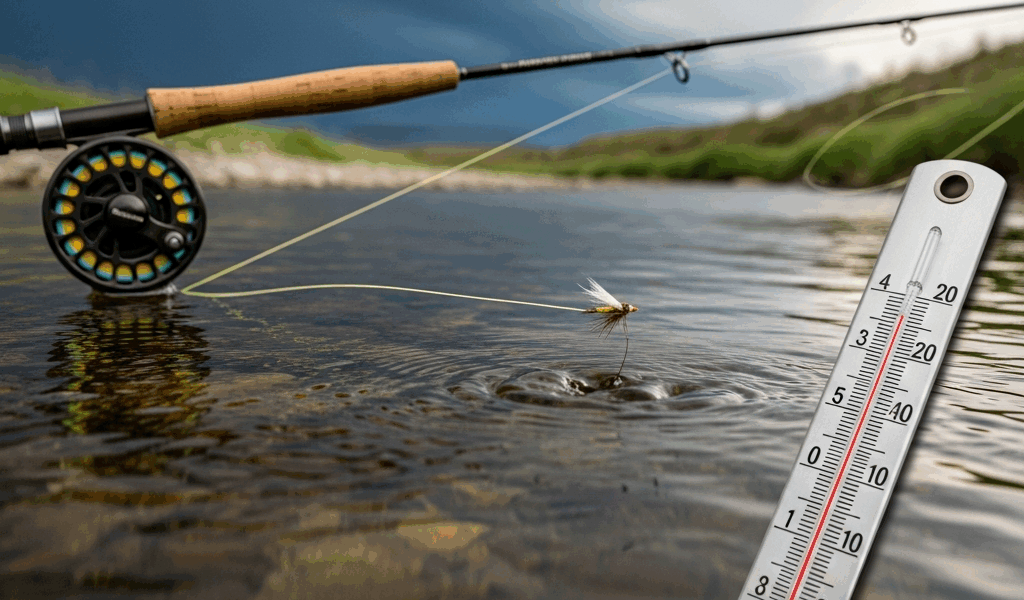
Why Trout Stop Hitting — The Real Reasons
Trout fishing has gotten complicated with all the bad advice flying around. “Change things up.” “Experiment with presentations.” You’ve read that a hundred times, and it’s told you nothing. What you actually need is a diagnosis — not a fortune cookie.
As someone who’s spent enough seasons on both sides of a dead bite, I learned everything there is to know about why trout shut down. Today, I will share it all with you.
The short answer: four things kill the bite. Water temperature pushing outside their comfort zone. Barometric pressure shifts ahead of weather. Fishing pressure conditioning the population. And presentation fatigue — trout that have seen the same offering so many times they’ve simply stopped caring. Each one has a different fix. Knowing which one is working against you on a given day separates the people who catch fish from the people who pack up early and blame the stream.
I’ve been both of those people. The difference matters more than any lure selection ever will.
How Water Temperature Kills the Bite and What to Do
Trout have a comfort window. Outside of 50°F to 65°F, things fall apart fast.
Above 68°F, dissolved oxygen drops. Trout stop hunting. They slide into deeper pools and press tight to cold-water seeps — places where groundwater bleeds into the stream. The feeding window disappears around midday in summer. I learned this the hard way on a July afternoon, casting through a stocked stream where trout had been gorging at dawn. By 10 a.m., every fish had vanished. I stood there for another 90 minutes like an idiot. Don’t make my mistake.
The fix is simple: fish early. Sunrise to 9 a.m. Get off the water before midday unless you’re willing to hunt deep structure and tributary mouths where cold water enters.
Here’s the specific move — find where smaller creeks flow into your main stream. Those inflows run 5 to 10 degrees cooler. Fish stack there in summer. Spring seeps are even better. You can actually confirm them with an infrared thermometer — they run $30 to $80 on Amazon, and I promise they’ll change how you read water. Completely different experience once you start seeing the thermal map of a stream instead of just guessing.
Cold water is the opposite problem. Below 45°F, trout eat far less. They’re not aggressive. Survival mode. A size 6 spinner that crushed it in October gets ignored completely in February.
What works: a 4-inch crappie minnow dead-drifted along the bottom in 42°F water. Retrieves should be glacially slow — count five full seconds between rod movements. Trout in cold water won’t chase anything. They’ll only eat if the food is almost stationary right in front of them.
One more thing. Always check depth temperature, not just surface. A thermometer reading to 3 feet down shows you refuges your surface-reading brain completely misses.
Pressure Changes and How to Read Them
Probably should have opened with this section, honestly. Most anglers ignore barometric pressure completely — and that’s a massive, fixable mistake.
A falling barometer triggers an aggressive feeding window. Trout sense the drop and feed hard for 2 to 4 hours before conditions deteriorate. Cast aggressively during that window. Use larger flies or lures. Cover water fast. Trout are in a hunting mood and they’ll tell you immediately.
But here’s where everyone goes wrong: the actual pressure number doesn’t matter nearly as much as the speed of change. A drop from 30.15 to 29.85 inches of mercury over 6 hours — that’s a real signal. Trout respond to it hard. A stable high sitting at 30.30 for three days? That’s when the bite dies and people start blaming the hatchery.
Bluebird high-pressure days are brutal. Water calm, light penetration at maximum, zero feeding stimulus. This is the condition behind most complaints about dead bites.
The fix: downsize everything. Size 14 hook instead of size 8. 3-inch fly instead of 4-inch. Slow your drift or retrieve by half. Match whatever insects are actually on the water. High-pressure trout demand precise imitation and small profiles — they’re not going to do you any favors.
Cloud cover helps even on high-pressure days. Overcast skies breaking up direct sunlight will push trout into shallower water. A bright, clear high-pressure day with full sun? They’re either at depth or not eating. Period.
Check a weather app before you fish. Look at pressure trends, not just the reading itself. One hour of fishing aligned with a pressure shift beats a full day of casting to unmotivated fish. That math always works out.
Presentation Fixes That Actually Work
Stocked trout and wild trout demand completely different approaches. But what is presentation fatigue, exactly? In essence, it’s when trout have rejected the same offering enough times that they’ve been behaviorally conditioned to ignore it. But it’s much more than that — it’s a population-level response, not just one fish having a bad day.
That’s what makes trout endearing to us anglers, honestly. They’re not dumb. They adapt. And heavily stocked, heavily fished water — put-and-take streams, the first mile below a hatchery — produces conditioned fish fast. They’ve seen Rooster Tails and Panther Martins a thousand times. Live bait or PowerBait produces when artificials go cold. A dozen California roaches or a golf-ball-sized chunk of Berkley PowerBait Chartreuse (the original still works, despite being on shelves since the early ’90s) will catch fish when everything else fails. I’ve watched this happen on crowded streams within sight of parking lots. The trout weren’t dumb. Just tired.
In less pressured water — or targeting wild fish — reverse everything. Go smaller. Lighter. More natural. Wild trout in clear water will refuse a size 8 hook on 8-pound monofilament and crush the same pattern on a size 14 hook with 4-pound fluorocarbon. I’m apparently a fluorocarbon convert and Seaguar works for me while standard mono never does in clear conditions. Same fly. Same drift. Completely different result.
If trout are visible but ignoring you, speed is usually the culprit. Slow the drift. Count to three between casts. Let the current do the work. I’ve recovered dozens of dead bites just by letting a nymph drift longer before picking up.
Depth matters too — maybe more than anything else. Been fishing the surface? Drop to the bottom. Been fishing deep? Try mid-column. A depth change often outperforms a full lure swap by a wide margin.
When Nothing Works — Last Resort Moves
Sometimes the answer is just to leave. So, without further ado, let’s get into when that’s actually the right call.
Water temperature at 71°F at 3 p.m. on a July afternoon? The bite won’t return until evening. You can spend two more hours casting into warm water, or you can come back at 6 p.m. when the temperature drops 2 degrees and everything wakes up. The second option isn’t quitting. It’s reading conditions correctly.
High-pressure system locked in? Sometimes waiting 24 hours matters more than trying every technique in the box. Come back when the forecast shows a front moving through. That’s not giving up — that’s efficiency.
On truly dead days, change the whole approach. Dry flies to nymphs. Open pool to fast water. Stocked section to wild-trout country a mile upstream. Sometimes the bite isn’t dead. You’re just fishing the wrong water entirely.
Trout fishing has off days. Reading conditions is a skill that builds over years, not a weekend. The anglers who catch fish consistently aren’t luckier — they’re faster at diagnosing why trout shut down and matching the fix to the actual problem. That’s the whole game.




Stay in the loop
Get the latest fish blog updates delivered to your inbox.