Largemouth vs Smallmouth Bass — Different Fish, Different Tactics
Bass fishing has gotten complicated with all the conflicting advice flying around. As someone who has spent probably a third of my waking thoughts on largemouth vs smallmouth since age twelve, I learned everything there is to know about how differently these two fish actually behave. Today, I will share it all with you.
I grew up on a weedy reservoir in central Ohio — classic largemouth water, warm and slow and full of milfoil. Didn’t touch a smallmouth until my mid-twenties, when a buddy physically dragged me an hour north to a rocky river system. I was humbled. Six fish for him. Zero for me. I stood there swapping lures in quiet embarrassment while he made it look effortless. That day changed everything about how I approach bass fishing. These are not the same fish in different colors. They want different things, live in completely different places, and they will absolutely punish you for confusing the two.
How to Tell Them Apart in 5 Seconds
Probably should have opened with this section, honestly. Tactics mean nothing if you don’t know what you’re holding — especially on mixed waters, which are far more common than most weekend anglers realize.
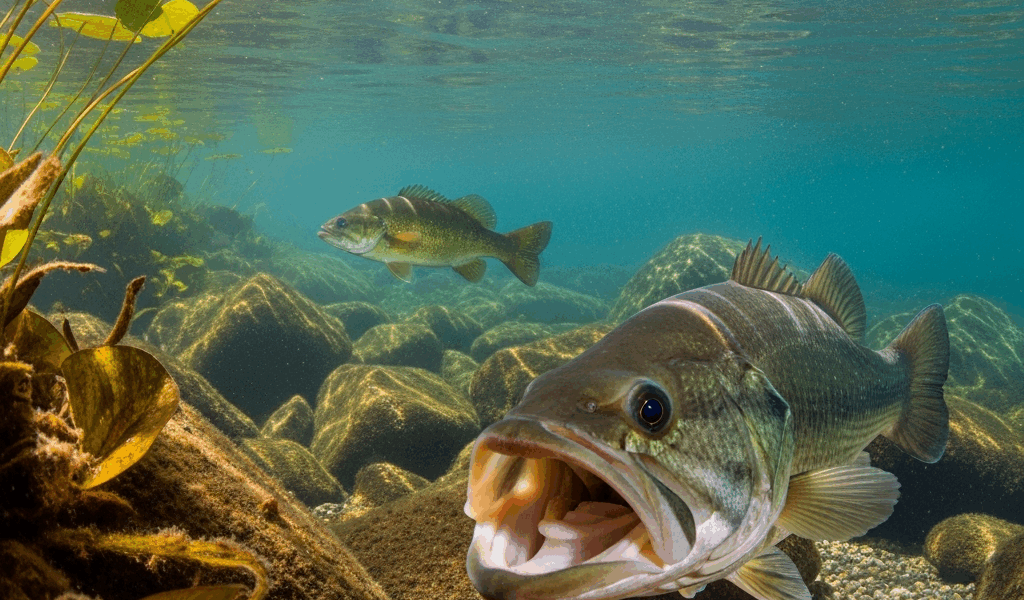
The jaw line is your fastest ID. On a largemouth, the upper jaw extends past the rear edge of the eye. Hard to miss. On a smallmouth, that jaw stops within the eye — it doesn’t cross that back boundary. One feature. Five seconds. Done.
Color works as your backup confirmation. Largemouth run green — sometimes almost olive — with a dark horizontal stripe running the length of the body. Smallmouth are bronze or brownish-gold, marked with vertical dark bars going top to bottom instead of a sideways stripe. Stained water will fool you on color. Clear water makes it obvious.
- Jaw past the rear edge of the eye — largemouth
- Jaw stops within the eye — smallmouth
- Green body with horizontal stripe — largemouth
- Bronze body with vertical bars — smallmouth
Don’t make my mistake. Early on I assumed any bass pulled from a river was automatically a smallmouth. Caught a genuine largemouth from a slow backwater eddy on a float trip and spent ten confused minutes second-guessing myself. Checked the jaw line — settled it immediately. Always check the jaw line.
Where to Find Each Species
But what is habitat preference, really? In essence, it’s the single clearest dividing line between these two fish. But it’s much more than just water type — it shapes everything downstream, from your lure choice to your line weight.
Largemouth Habitat
Largemouth are shallow-water ambush predators. Full stop. They want vegetation — lily pads, milfoil, hydrilla, reeds, anything they can hide behind and wait. Slow, warm water suits them perfectly. A weedy cove on a humid August afternoon is basically largemouth paradise. They’ll push into eighteen inches of water when feeding hard, and they relate to docks, fallen timber, and laydowns basically year-round.
On reservoirs, pay attention to bottom transitions — where hard bottom meets soft mud, where grass lines drop into eight or twelve feet of water. A 45-degree sloping bank with scattered cover dropping into that depth range? That’s a reliable address. I’ve returned to the same three spots on my home lake for fifteen years running. They keep producing.
Smallmouth Habitat
Smallmouth want almost the exact opposite. Rocky bottom. Current. Cooler, clearer water. Rivers with gravel and cobble substrate hold them well through the whole season. On natural lakes, chunk rock shorelines and boulder points are where you start — plus any submerged rock pile your graph picks up. They suspend over deep structure in ways largemouth almost never do. That’s what makes smallmouth endearing to us river anglers — they reward the angler who actually reads water.
Frustrated by a blank morning on a local river, I stopped casting randomly and started watching where strikes actually came from. Every single one — behind a mid-current boulder, on the calm seam right along the downstream edge. Smallmouth use those rocks exactly the way largemouth use dock posts. Same logic. Completely different real estate.
Water clarity matters more with smallmouth. They thrive when visibility reaches six to eight feet. In those conditions they get spooky — which brings us directly to gear choices.
Lure Selection — What Each Species Wants
So, without further ado, let’s dive in — because this is where most casual bass anglers genuinely go wrong. They grab a rod rigged for one species and expect the other to cooperate. It rarely works.
What Largemouth Want
Largemouth fishing rewards aggression and bulk. A 10-inch Berkley PowerBait Power Worm in junebug, Texas-rigged on a 4/0 straight-shank hook, punched into thick vegetation — that’s a legitimate big-fish tactic. So is a 3/4 oz. black-and-blue jig with a craw trailer dragged through the same cover. You can size down for post-front fish, sure, but your baseline presentation should have some mass behind it.
Reaction baits belong here too. A Booyah Pad Crasher worked over thick grass will pull blowups from largemouth that won’t even glance at a finesse rig. The heavy cover protects them — so they’re willing to fully commit when something triggers them.
What Smallmouth Want
Smallmouth fishing rewards patience and subtlety. I’m apparently a Ned rig convert now and the Z-Man TRD MushroomZ at 1/6 oz. works for me while everything bulkier never seems to click on clear river systems. Pair it with a ZinkerZ trimmed down, drag it slowly along a rocky bottom — it looks like almost nothing and catches fish everywhere I’ve thrown it.
Small crankbaits on current seams are deadly too. A Strike King KVD 1.5 in a natural crawfish pattern covers water fast and efficiently. Tube jigs on a 3/16 oz. head remain a classic for obvious reasons — that spiral fall mimics a dying crawfish in a way smallmouth genuinely cannot seem to ignore.
Drop the lure size. Trim your plastics down. Fish slower than feels comfortable. That’s the whole adjustment, honestly.
Line and Tackle Differences
While you won’t need two completely separate fishing setups, you will need a handful of specific adjustments when switching between species. I learned this the expensive way — burned an entire afternoon on a clear Tennessee river using 17 lb. monofilament pulled straight from my largemouth rod. Three hours. Zero bites. Switched to 8 lb. fluorocarbon and caught a fish on my second cast. That was a long drive home.
Smallmouth live in clear water. They see your line — don’t let anyone tell you otherwise. Fluorocarbon might be the best option, as smallmouth fishing requires near-invisibility below the surface. That is because in six to eight feet of clear water, heavier monofilament is essentially a red flag. A Seaguar InvizX in 8 lb. on a 2500-series spinning reel handles the majority of smallmouth situations I run into. That’s my go-to. Has been for years.
Largemouth in heavy cover flips the equation entirely. You need to horse fish out of weeds and timber before they can wrap you — finesse line snaps. Thirty to fifty lb. braid on a 7’3″ heavy casting rod with a fast tip gives you the power and sensitivity those situations demand. In open-water or finesse largemouth scenarios, 12 to 15 lb. fluorocarbon on a medium spinning rod handles things cleanly.
- Smallmouth in clear water — 6 to 10 lb. fluorocarbon on spinning gear
- Largemouth in heavy cover — 30 to 50 lb. braid on baitcaster
- Largemouth finesse or open water — 12 to 15 lb. fluorocarbon on spinning gear
I’m apparently someone who kept using the wrong line long after I should have known better — don’t make my mistake. The short version: smallmouth will expose lazy technique in ways largemouth simply won’t bother to. Fish both species seriously and you’ll sharpen completely different skills. That combination builds a more complete bass angler than chasing either one alone ever could.


Stay in the loop
Get the latest fish blog updates delivered to your inbox.