Best Freshwater Fish for Beginners to Catch (and Where to Find Them)
If you’re searching for the easiest freshwater fish to catch as a beginner, I’ll save you three hours of forum-diving: bluegill, channel catfish, stocked rainbow trout, and largemouth bass. In that order. I grew up fishing farm ponds in central Ohio with a Zebco 33 my uncle handed me when I was eight years old, and those four species are what built every skill I have today. This isn’t a ranked list based on someone else’s opinion — it’s based on what actually puts fish in your hands on a first trip, a second trip, and every trip after that when you’re still figuring out the difference between a strike and your hook snagging on a submerged branch.
Beginner fishing is brutally honest. If you don’t catch something in the first hour, most people quit. So everything in this article is ranked and built around one goal — getting a fish on your line as fast as possible, then giving you the next step up when you’re ready for it.
#1 — Bluegill (Easiest Fish in Freshwater)
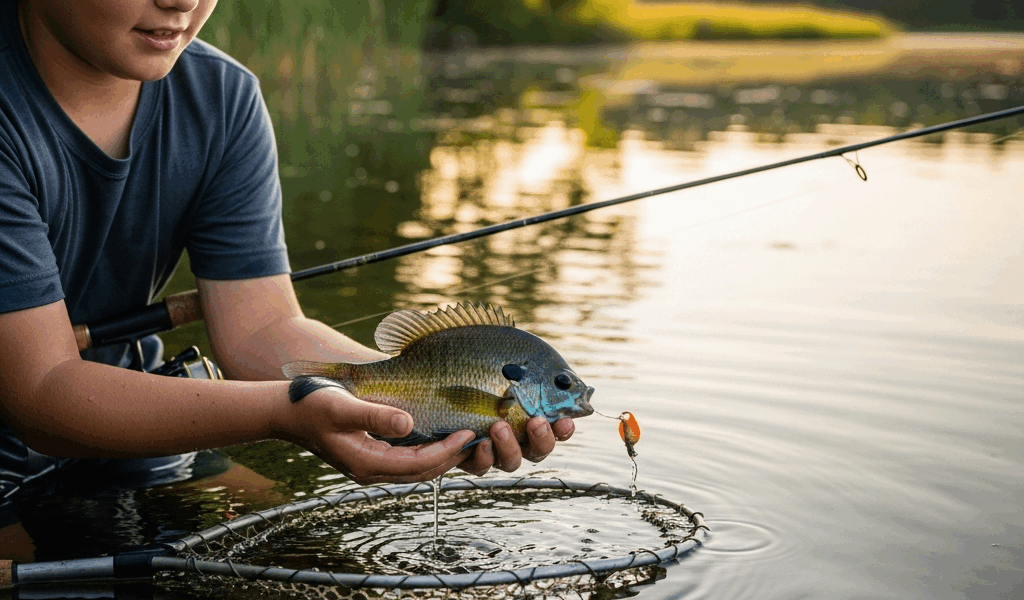
There is no easier fish. I mean that completely without qualification. Bluegill live in nearly every lake, pond, river, and creek in the continental United States. They sit in shallow water near weeds and dock pilings and fallen logs and they eat almost anything that moves in front of them. If you walk up to a body of freshwater and drop a hook in, there’s a better than average chance a bluegill is six feet away from you right now.
Here’s the exact setup I’d hand a first-timer:
- A light or ultralight spinning rod — the Shakespeare Ugly Stik GX2 in 5’6″ ultralight runs about $30 and is nearly indestructible
- 6 lb monofilament line (Stren Original works fine, about $5 for 330 yards)
- A small red-and-white bobber, the classic round kind, set about 18 inches above the hook
- Size 8 or 10 Aberdeen wire hook — small hooks matter here, bluegill have small mouths
- Half a nightcrawler threaded onto the hook
Cast that rig toward any visible weeds in shallow water — three to six feet deep is ideal — and wait. If your bobber hasn’t moved in ten minutes, reel in slowly and cast to a different spot. Bluegill are aggressive and they’re fast. You’ll know immediately when you’ve got one. They pull sideways, which makes them feel bigger than they are on ultralight gear, and that’s genuinely fun.
Best time to go? Any time. Year-round. They’re slightly more active in the morning and evening, but I’ve caught them in the middle of a July afternoon with the sun straight overhead while eating a sandwich. They’re that cooperative. In spring, especially around Memorial Day weekend, they’re spawning in very shallow water and they get almost irritatingly easy to catch — like, you start to feel bad about it.
One mistake I made early on was using hooks that were too big. I was grabbing whatever size 4 hooks were in the tackle box and wondering why I kept getting short strikes. Downsizing to a size 10 hook immediately fixed that. Small details like hook size matter more than people tell beginners.
#2 — Channel Catfish
Probably should have opened with this section, honestly — because channel catfish are stocked in an enormous number of city ponds, municipal lakes, and state park fishing areas across the country, which means they’re not just catchable, they’re practically waiting for you with their fins out.
The rig is dead simple. A slip sinker rig: thread a 1-oz egg sinker onto your main line, tie on a small barrel swivel, then attach an 18-inch leader of 12 lb fluorocarbon (Seaguar Red Label is reliable and runs about $10 for 50 yards), and finish with a size 2 or 1/0 bait hook. Put your bait on the bottom. That’s the whole technique.
For bait, chicken liver is the gold standard. It’s cheap — usually under $3 a pound at any grocery store — and catfish go absolutely insane for it. The problem with chicken liver is that it falls off the hook constantly. Wrap it in a small piece of nylon stocking material or use a bait holder hook with barbs on the shank. Alternatively, pick up a container of Berkley Gulp! Catfish Bait or Magic Bait’s chicken blood dough — both stay on the hook better and work extremely well.
Catfish are primarily nocturnal. Show up at a city pond around sunset and fish until 10 or 11 PM. Bring a headlamp (the Black Diamond Spot 400 is $35 and worth every cent), a camp chair, and patience. The bite often turns on hard after full dark. Set your rod in a forked stick or a rod holder, keep the bail open or your clicker on, and wait for the rod to load up. When a channel cat runs with bait, it’s not subtle — your rod tip starts pumping and line peels off fast.
Channel cats in stocked ponds commonly run 2 to 5 pounds, which on a medium rod feels like a real fish. This is also a great species for kids because the wait-and-react style of fishing keeps them engaged without requiring constant casting.
#3 — Rainbow Trout (Stocked)
Stocked rainbow trout are a different category than wild trout. Wild trout in clear streams require matching hatches, drag-free drifts, and years of experience. Stocked trout were raised in a hatchery on pellet food and have been in their current lake for maybe two weeks. They are not the same animal in terms of how hard they are to catch.
Frustrated by catching nothing but weeds on my first trout trip, I eventually learned that the single best beginner approach for stocked rainbows is a jar of Berkley PowerBait floating dough bait in chartreuse or rainbow color. Seriously. Fish raised on pellets respond to this stuff like a dog to a treat. Set up a basic bottom rig with a sliding egg sinker, a barrel swivel, a 2-foot fluorocarbon leader, and a size 14 treble hook. Mold a small ball of PowerBait — about the size of a pea — around the treble hook so it floats just off the bottom. Cast it out, set your rod down, and wait.
Timing matters more with trout than bluegill. The best seasons are spring (March through May) and fall (September through November). Most state fish and wildlife agencies stock heavily during these windows because the water temperature is in the range trout prefer — roughly 50 to 65°F. Summer stocking happens but the fish don’t stay catchable as long in warm water.
The key to this species is finding recently stocked water. More on that in the last section, but know that trout fishing is 80% location and timing, 20% technique. Find fresh stocking, use PowerBait, and you will catch fish.
#4 — Largemouth Bass
Largemouth bass require slightly more from you than the previous three species. Not a lot more, but some. You need to understand that bass relate to structure — submerged logs, dock pilings, weed edges, rocky points — and you need to put your bait near that structure. They don’t always chase things down in open water the way a hungry catfish might hit anything that smells interesting.
The beginner setup that works best is a 7-inch Zoom Trick Worm in watermelon red or black with a 3/0 offset worm hook, rigged Texas-style (hook point buried in the plastic so it’s weedless). No weight, or a very light 3/16-oz bullet sinker if the water is more than five feet deep. Cast it near visible cover — next to a dock, along a weed line, around a fallen tree in the water — and let it sink slowly. Then drag it along the bottom with occasional short hops. Bass hit soft plastics anywhere in the retrieve, often on the fall.
The reward for figuring out bass is real. A 3-pound largemouth on a medium spinning rod is a legitimate fight. They jump. They run. They shake their heads. Landing your first decent bass is a moment you actually remember, which is something you can’t quite say about your fourteenth bluegill of the morning (though those are still fun).
Bass are available year-round but spring — especially the pre-spawn period in April and May — is when even large fish move shallow and become far more catchable. Target water temperatures in the 58 to 68°F range and look for any structure in water between 2 and 8 feet deep.
Where to Actually Go
This is the section most beginner fishing articles skip, which baffles me because knowing what to catch matters a lot less than knowing where to go catch it.
Start here: your state’s fish and wildlife agency website. Every state has one, and almost all of them publish stocking schedules for trout and other species. Search “[your state] fish stocking schedule 2024” — you’ll find a calendar or a PDF that shows exactly which lakes and ponds are being stocked with trout, catfish, or bass, and when. Plan your trip within two weeks of a stocking event at a location near you. That’s it. That single piece of information will put more fish in your hands than any technique upgrade.
For bluegill and bass fishing without stocking reports, look for:
- City and county park ponds — almost always have panfish and bass, almost never crowded on weekday mornings
- State park lakes — maintained, accessible, often have courtesy docks and fish cleaning stations
- Small reservoirs and flood control lakes — underrated fisheries that most people drive past
- The Army Corps of Engineers manages hundreds of lakes across the US — corps.usace.army.mil has a lake locator tool and many of these are free to fish with just a state license
Speaking of licenses — get one before you go. Most states sell them online in about five minutes. An annual freshwater fishing license runs $15 to $30 depending on your state. Fishing without one is a fine that starts around $100 and ruins the trip in a way that’s completely avoidable.
The app onX Maps has a fishing layer that shows public water access points, and the FishBrain app has user-reported catch logs that can tell you what’s being caught at a specific lake right now. Neither is perfect, but both are useful when you’re trying to decide between two nearby options.
Pick one species from this list. Pick one nearby body of water from your state stocking schedule or park system. Go early on a weekday morning when it’s quiet. Bring more bait than you think you need and fewer tackle options than you think you want. The anglers who catch the most fish aren’t the ones with the most gear — they’re the ones who showed up.

Stay in the loop
Get the latest fish blog updates delivered to your inbox.