What It Actually Means When Fish Are Jumping
Fishing has gotten complicated with all the conflicting advice flying around. But this one drives me absolutely insane — watching fish explode out of the water every few seconds while your lure sits there collecting nothing. Three splashes in ten seconds. You cast. Dead silence. You cast again. Same result. I’ve been there more times than I can count, and I finally understand why it happens.
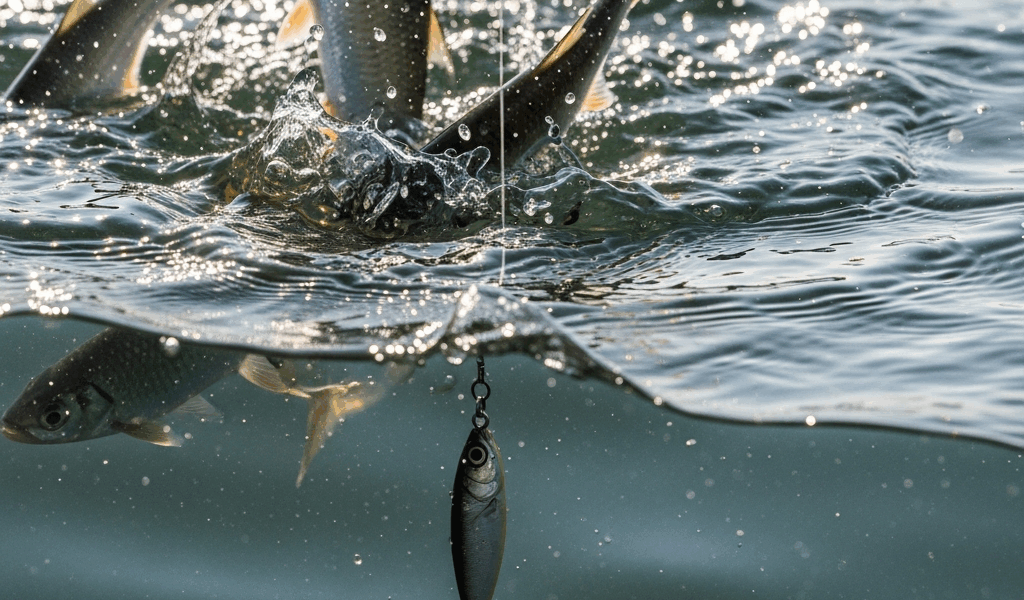
Fish jump for three distinct reasons. Only one of them has anything to do with eating. First, they chase baitfish toward the surface and sometimes breach mid-hunt — that’s a genuine feeding jump. Second, they bolt out of the water when something spooks them — a predator, a boat motor, a shadow crossing wrong. That tells you nothing useful about whether they’re hungry. Third, they rise to gulp oxygen when water temps climb or oxygen levels drop. That one has absolutely nothing to do with food.
Here’s the part nobody tells you. The depth where fish jump is not the depth where they feed. A school of largemouth hammering shad near the surface is chasing fleeing prey upward — but those shad, and the bass behind them, spend the bulk of their time hunting somewhere between three and eight feet down. You’re casting at the symptom. Not the feeding zone. That’s why you see all that chaos and land nothing.
They Are Not Feeding on Top — Here Is Why That Matters
When you see fish jumping in a tight area, they’re in pure pursuit mode. Panicked baitfish race for the surface. Bass or stripers follow. For maybe five seconds, it looks like a blender. Then the baitfish scatter or dive, and the predators follow them straight back down. By the time your lure lands where the action was, the fish have already moved — or they’ve dropped to a depth your topwater plug will never reach.
But what is match-the-hatch thinking? In essence, it’s matching your lure’s size, color, and movement to whatever the fish are actually chasing. But it’s much more than that — it’s reading the specific speed and direction of the prey, not just the general look. Those jumping fish couldn’t care less about a 5-inch crankbait in chartreuse and black. They’re locked onto 2-inch shad moving fast in one direction. Casting directly into the jump is usually the wrong call because you’re always arriving late to a party that already ended.
Five Fixes to Try When You Can See Fish But Cannot Catch Them
1. Downsize the lure and slow the retrieve. This is where most anglers go wrong — badly wrong. Big splashes make you want to throw bigger baits. Don’t. A 2-inch swimbait or small topwater is almost always the right call. Retrieve it slowly. Unnaturally slowly. I learned this the hard way on a June morning at Table Rock Lake. Switched from a 4-inch Berkley PowerBait to a 2-inch shad pattern swimbait on a 1/16-ounce jighead. Landed three fish in fifteen minutes. Don’t make my mistake and waste an hour throwing the wrong size.
2. Switch to a subsurface presentation just below the activity. Cast a soft jerkbait or suspending twitch minnow three to five feet outside the jump zone — not into it. Let it sink to four or eight feet. Twitch it. Pause it. Hold it there. A Rapala X-Rap Suspending in size 06 works exceptionally well here because it stays in the strike zone longer than a floater — at least if you give it a two-second pause between twitches. That pause is everything.
3. Cast ahead of the school’s direction rather than at the splash. Read which way they’re moving. Lead them like you’re hunting birds. Cast ten feet in front of the travel direction. Your lure will be sitting right in their path when they swing back through. This kills the “by the time it lands, they’re gone” problem entirely. It takes practice. It is absolutely worth the practice.
4. Try a walk-the-dog lure during the quiet moments. When jumping stops for twenty or thirty seconds, the school is regrouping below the surface. That’s exactly when a Zara Spook or a Lucky Craft Sammy 85 becomes genuinely dangerous. Walk it slowly across the zone. The moment you see a swirl underneath it — pause. Two full seconds. Predatory fish cannot resist a baitfish that suddenly goes still.
5. Fish the edges, not the center. The middle of an active school is chaos — all that commotion pushes a pressure wave outward that spooks the fish on the periphery. Those edge fish are calmer. Less jumpy. More likely to actually eat something. Cast to the outer edge every ten to fifteen seconds, moving to a different spot along the perimeter each time. Patience here beats aggression almost every single time.
Species-Specific Notes for Bass, Trout, and Stripers
Largemouth and smallmouth bass: A schooling blitz on shad gives you maybe five to ten minutes of real feeding activity. The fish aren’t thinking carefully — they’re reacting. Downsize and work the edges. A 2-inch swimbait on a 1/8-ounce jighead closes deals faster than anything else I’ve thrown. If they still won’t bite, you’ve either caught the tail end of the window or your boat position has already blown the whole situation.
Trout — especially in streams and tailwaters: Jumping trout are usually chasing emerging insects or small fry, but they feed almost entirely subsurface. A size 18 or 20 soft-plastic nymph drifted through the current seam just behind the jump site will catch them when nothing on top will. Trout are methodical. I’m apparently the impatient type, and that has cost me fish. They won’t chase a surface lure if they’re locked onto a specific hatch. Match the insect size and color or go home empty.
Stripers and hybrids: These fish blitz hard, but they spook from noise and shadow faster than you’d expect. A 3-inch shad-pattern swimbait cast beyond the activity and retrieved back through it outperforms topwater almost every time. Stripers hit like a freight train but suspend deeper than bass — fish subsurface first. A 1/2-ounce silver or chartreuse spoon is also worth keeping tied on. It cuts through chaos and still gets strikes when nothing else will.
The One Mistake That Kills Your Chances Every Time
Probably should have opened with this section, honestly. The single biggest error anglers make is motoring too close, casting into the same ten-foot circle repeatedly, and letting their shadow cross the school. That’s three mistakes that usually happen together in about ninety seconds.
Active fish schools have a fear radius — a real one. Blow past it and they scatter or shut down completely. Position your boat fifty feet from the activity. Not twenty. Fifty. Use the trolling motor on its lowest setting and approach from an angle where your shadow trails away from the fish. Make three casts to any given zone. Nothing after three? Move thirty feet along the edge and start over. Treat the school like it’s already halfway spooked, because it probably is. I’m apparently the kind of angler who had to learn that lesson four times before it stuck, and pushing in close never once worked for me while hanging back almost always did.
Next time you watch fish jumping and refusing to bite, remember what you’re actually watching — pursuit, not feeding. Get smaller. Get deeper. Get your lure positioned ahead of where they’re going, not where they just were. That adjustment alone turns a frustrating morning into something worth talking about on the drive home.

Stay in the loop
Get the latest fish blog updates delivered to your inbox.