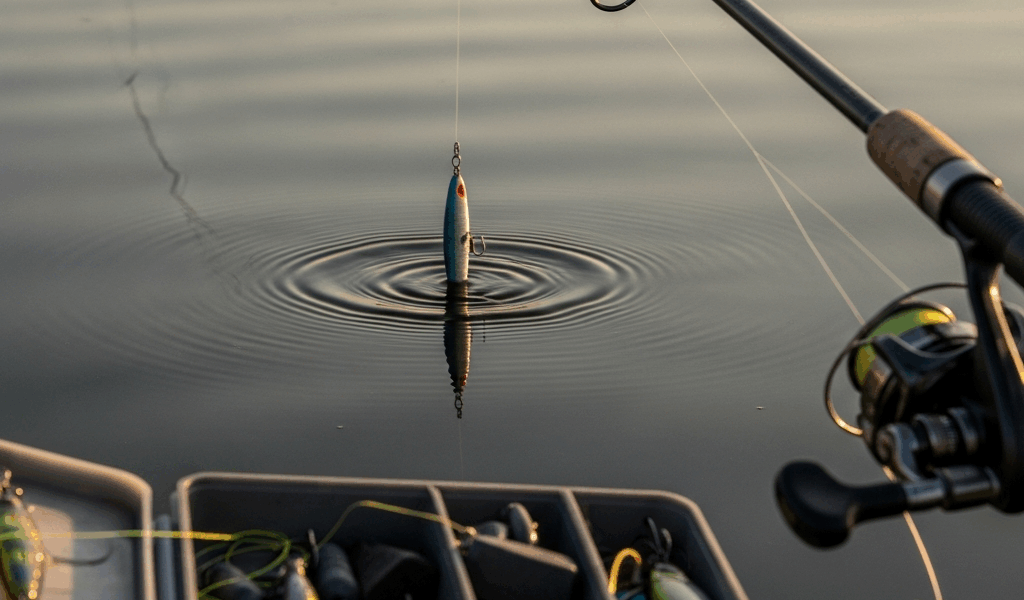
Why Fish Stop Biting — And How to Fix It Fast
Figuring out why fish stop biting has gotten complicated with all the conflicting advice flying around. As someone who’s spent the better part of 20 years wading smallmouth rivers and bass lakes at stupid-early hours, I learned everything there is to know about dead bites the hard way. Today, I will share it all with you.
This article includes affiliate links. We may earn a commission at no extra cost to you.
Picture this: it’s 7 a.m., you’re standing knee-deep in 58-degree water, and you’ve already landed three smallmouth in the 2 to 3-pound range. Then — nothing. Not a tap. Not a follow. The same 3/8 oz chartreuse spinnerbait that was absolutely on fire five minutes ago is now invisible. What separates anglers who salvage that situation from those who pack up by 9 a.m. is pretty simple: they don’t blame the fish. They diagnose first, then adjust with purpose instead of panic.
The Most Common Reasons Fish Go Quiet
Barometric pressure and weather shifts are the silent bite-killers most anglers completely ignore. But what is barometric pressure doing to fish, exactly? In essence, it’s triggering their lateral line and inner ear — sensory systems far more sensitive than anything we carry on the boat. But it’s much more than that. A fast-moving cold front can flip the feeding switch in under 20 minutes. Don’t wait for the sky to change before you adjust.
Your position is spooking fish — and probably more often than you think. A boat engine idling four feet too close, footsteps on a dock, your shadow crossing the shallows. I once watched a guide kill a perfect topwater bite by nudging the trolling motor just slightly forward for a “better casting angle.” We didn’t get another strike for 45 minutes. That was on a clear-water Michigan lake, mid-August. The fish didn’t forgive it fast.
Water temperature fluctuations slow metabolism and kill feeding aggression fast. A 5-degree drop doesn’t just make fish less interested — it changes where they physically hold. A largemouth comfortable at 65 degrees might retreat entirely to a deeper, cooler refuge at 60. That’s not sluggishness. That’s survival instinct.
Spot burnout from repeated pressure is real and it’s testable. If you’ve dragged a lure over the same 20-foot stretch 40 times, whatever fish are still there have either bolted or completely shut down. That’s not paranoia — it’s documented fish behavior. Move the cast angle before you move the boat.
Mid-day transitions create dead zones on almost every body of water. The window between 10 a.m. and early afternoon is notoriously cold on clear-water lakes when the sun is overhead. Fish retreat to shade, deeper holding structure, and laydowns. That’s what makes time-of-day awareness so endearing to us anglers — because once you understand it, you stop fighting the water and start reading it.
Change Your Presentation Before You Change Your Spot
Probably should have opened with this section, honestly. Most anglers respond to a dead bite by moving immediately — and that’s exactly backward. Before you break down and relocate, exhaust every presentation option in the same zone. So, without further ado, let’s dive in.
Slow down first. This is the most underused adjustment in fishing, full stop. If you’ve been burning a crankbait on a fast retrieve, switch to a methodical pace with a full 2-second pause between cranks. If you’re jigging, let the lure sit 3 to 5 seconds on bottom instead of hopping it aggressively. Fish in a neutral feeding mood respond to lethargic, wounded-prey signals — not flash and action.
Downsize your lure immediately. I’m apparently a slow learner on this one, and downsizing works for me now while my old instinct to upsize never did. Don’t make my mistake. I once had a steady morning bite on a 3/8 oz white spinnerbait — caught fish for 90 minutes straight. When the sun broke through around 9:15 and the bite stalled completely, I switched to a 1/8 oz finesse worm on the same weed edge. Four more fish in 15 minutes. The spot was never the problem. The presentation was.
Drop at least half a size. Move from a 4-inch soft plastic to a 2.5-inch. Trade the 1/2 oz jig for a 1/4 oz Ned rig head. Smaller profile signals vulnerability — and it requires less commitment from a fish that’s already suspicious.
Switch bait types with a reason behind it. If artificials were producing all morning and suddenly won’t, move to live bait — shiners, crawdads, nightcrawlers depending on your target species. The reverse holds too. Live bait gone quiet? Try a metallic finesse presentation that triggers a reactive strike rather than a calculated feeding response. Those are two completely different things.
Change depth by one structural level — not two. Fish were hitting shallow transition banks and the bite died? Drop to the adjacent 8 to 12-foot shelf before you go anywhere else. Were they suspended mid-column on submerged cover? Move to the base of that same structure. Vertical repositioning is faster and smarter than burning gas to find a new spot.
Follow this sequence in order. Most anglers skip straight to moving because slowing down and downsizing feel passive — almost like giving up. That hesitation costs hours of productive water.
When to Move and How to Read a Dead Spot
After you’ve worked slower speeds, smaller lures, and depth changes through the same zone and still have absolutely nothing, the spot may genuinely be burned out. Or it may just need rest. Those are very different diagnoses.
A truly dead spot shows zero response variation. You’re not getting bites during slower windows, at color transitions, at any depth — nothing, period. That’s different from a spot that produced at 7 a.m. and won’t now. First scenario means move. Second scenario means pause, not abandon.
If fish were active in that zone this morning, they’re almost certainly still within 50 to 100 feet of where you were working. They’ve gone shallow with changing light, or dropped to adjacent break structure. Before you leave entirely, scan the transitions within casting distance — next drop-off, nearby weed edge, rock formation. Ninety percent of the time, fish migrated five feet along the same structure vertically. Not 200 yards across the lake.
A burned spot deserves 30 to 45 minutes of rest minimum. If it was producing hard and went completely silent — come back in 2 to 3 hours. Fish remember pressure. A brief absence resets their confidence more reliably than waiting for the perfect tide or moon phase.
How Weather and Light Changes Shut Fish Down
A cold front doesn’t just kill a bite — it reprograms fish behavior within minutes. Frustrated by cold-front shutdowns and losing fish after the first good hour, I started keeping a log of conditions, baits, and response times over three seasons. The pattern was clear. When barometric pressure drops and air temperature follows, fish pull tight to hard bottom structure and completely ignore fast-moving lures. Your response: slow-crawl a 1/4 oz jig with a small craw trailer across gravel or rock bottom. Methodically. That presentation will catch fish when a spinnerbait draws nothing.
High bright sun in clear water is a depth and shade problem — not a “fish aren’t biting” problem. Fish abandon shallow zones for deeper refuge and hard shadow lines from overhanging cover. Move deeper. Target the darkest edges. Fish docks, laydown trees, undercut banks. Light penetration is the variable. Shade is the solution.
Post-storm conditions create feeding windows most anglers completely miss. For 2 to 4 hours after a heavy rain or thunderstorm clears through, fish feed aggressively as water clarity stabilizes and dissolved oxygen levels normalize. This new pattern took off several years later in my fishing approach and eventually evolved into the tactic serious tournament anglers know and rely on today — hit the water fast after a storm passes, use larger more visible lures, and cover water quickly. The dead window is during the storm itself, or in the 30 minutes right after. Not for hours.
Quick Reset Checklist When Nothing Is Working
- Check your line first. Inspect the first 6 feet for frays, nicks, or discoloration. Retie your knot — most failures happen right at the connection, not mid-line.
- Test hook sharpness. Drag the point across your thumbnail. It should catch and drag. If it glides smooth, replace it — at least if you want any chance of a solid hookset.
- Fix your shadow position. Move so your shadow doesn’t cross your casting zone. Takes 30 seconds. Solves more dead bites than most anglers will ever admit.
- Kill the noise immediately. Engine off. Step quietly. Wait two full minutes before you resume casting.
- Drop lure size by half. Smaller before you go elsewhere — every single time.
- Slow your retrieve by 40 percent. Count to three instead of one between rod actions.
- Shift to high-contrast color. Been fishing natural browns and greens? Try white, chartreuse, or black. Been fishing bright? Go natural. The contrast change alone triggers reaction bites.
- Move to deeper adjacent structure. Stay in the zone. Shift depth first — always depth first.
While you won’t need a full tackle overhaul, you will need a handful of minutes and some honest self-assessment on the water. Run this checklist in real time. Don’t overthink each step — execute it in 5 to 10 minutes and watch what changes.



Stay in the loop
Get the latest fish blog updates delivered to your inbox.