Why Pier Fishing Is the Best Way to Start
Pier fishing has gotten complicated with all the conflicting advice flying around. Every article promises the “ultimate beginner guide,” then buries you in gear lists and technical jargon. As someone who fishes every weekend at a local coastal pier, I’ve learned everything there is to know about what actually matters for beginners — and what’s just noise. Today, I will share it all with you.
Here’s what most of those articles miss: you don’t need much, and the fish are already there. I’ve watched hundreds of people walk down my regular boardwalk convinced they need a $400 setup and some kind of secret knowledge. They don’t. Neither did I when I started.
The barrier to entry is genuinely low. No boat. No trailer. No gas money for a 40-mile drive to a boat ramp. You park, walk maybe fifty yards, and you’re fishing. Last month on a Saturday morning, I watched a 72-year-old woman catch her first flounder ever — using a $15 rod combo from a discount sporting goods store. First fish of her life. She was grinning like a kid.
Piers work because fish congregate around them. The structure creates habitat. Small baitfish hide in the pilings. Larger fish come hunting. This isn’t theory — it’s just ecosystems doing what ecosystems do. The fish don’t care if you’re a beginner. They’ll bite.
You get saltwater or freshwater fishing depending on your region. You fish on your own schedule. Tuesday sunset? Go. Nobody’s checking. The pier’s open.
Weather matters less than people think, too. Rain doesn’t stop me. Wind usually means better fishing, honestly. Cold fronts happen, sure — but I’ve caught plenty of fish in conditions that looked terrible on paper. Bad weather often means fewer crowds and more aggressive feeding. That’s a trade I’ll take every time.
Essential Pier Fishing Gear — Under $100 Total
Probably should have opened with this section, honestly. Most beginners stress hard about cost. I spent $200 on my first setup because I didn’t know better. Don’t make my mistake.
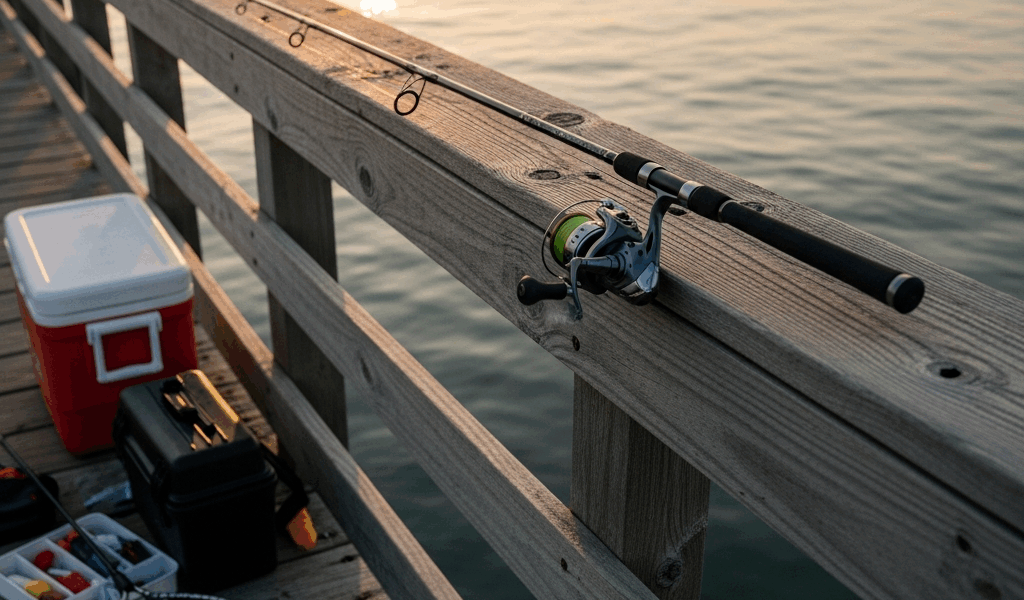
Start with a rod and reel combo — $40 to $50 is the sweet spot. A Shakespeare Ugly Stik GX2 or a Shimano Sienna FE will do everything you need. Not fancy. Built to last. There’s a guy at my pier who’s been using the same Ugly Stik for three years straight. Catches fish constantly. That’s your benchmark right there.
Get 8-pound to 12-pound monofilament line. A 100-yard spool runs $3 to $5. I’m apparently rough on line — I snap rigs on pilings, lose hooks to sharp shells, occasionally cut myself being careless — so I burn through it faster than most. Keep two spools in your tackle box regardless.
Your tackle box needs basics:
- Assorted hooks in sizes 1/0, 2/0, and 3/0
- Small barrel swivels to prevent line twist
- Split shot sinkers in various weights
- A handful of floats or bobbers
- Wire cutters or old scissors
- A small flashlight
All of that runs $15 to $20 at any tackle shop. Don’t buy a hundred hooks. Ten of each size and refill as needed — that’s the move.
Bait is your biggest variable. Fresh shrimp costs $6 to $8 per pound. Mullet runs around $12. Squid sits at $5 to $7. A pound of shrimp gives you 40 to 50 individual baits depending on size. That covers a full day of fishing, easy.
Early on I kept buying live bait when dead bait works just fine — maybe my worst beginner mistake. Live bait spoils faster, needs an aerated container, and costs more. Dead shrimp catches just as many fish. Store it on ice in a small cooler and stop overthinking it.
Skip the tackle backpack. Use an old 5-gallon bucket with a lid instead — drill a few holes in the bottom for drainage, toss in a small towel, your tackle box, sunscreen, and snacks. Total cost: maybe $5 at a hardware store. Last weekend I watched a guy with a $700 setup fishing next to someone running a plain bucket rig. The bucket guy caught more fish. I’m apparently not even surprised by that anymore.
Polarized sunglasses might be the best option here, as pier fishing requires reading the water constantly. That’s because you’ll spot feeding fish, see baitfish schooling near the pilings, notice current shifts. $20 to $30 and your success rate jumps immediately. This one’s non-negotiable.
Everything listed above totals $80 to $90. You’re ready to fish.
What You Can Catch from a Pier
Species vary wildly depending on geography and season. Atlantic piers produce different fish than Gulf Coast piers. Pacific piers are different again — so let’s break it down by region.
On the Atlantic side, you’re looking at Spanish mackerel, Atlantic mackerel, croaker, spottail bass, sheepshead, and flounder. Summer means mackerel dominate. They’re aggressive, fast, and genuinely exciting on light tackle — a mackerel hits hard, your drag screams, and you’re suddenly not bored anymore. That’s what makes mackerel season endearing to us pier fishing regulars.
Croaker and spottail bass show up spring through fall. Usually under a pound, but reliable. They eat squid and shrimp without drama. They won’t test your gear, but they’ll show up consistently when other species don’t feel like cooperating.
Sheepshead appear in fall and winter. Weird-looking fish — human-like teeth, I’m not joking — and they crush hard-shelled prey like crabs and barnacles. Tricky to hook because they bite clean and spit soft baits fast. Once you hook one properly, though, you know it. A 2-pound sheepshead fights like a 5-pound croaker.
Flounder arrive in fall. Bottom feeders. Different technique required — I’ll cover that next. They taste excellent, which is why most beginners target them specifically once they hear about them.
Gulf Coast piers yield redfish, spotted seatrout, Spanish mackerel, and pompano. A 10-pound redfish will test your gear and your patience simultaneously. Spotted seatrout are beautiful and delicious. Pompano require specific small baits and light tackle, but they’re worth the focus if you’re willing to dial in your approach.
Pacific piers produce rockfish, perch, lingcod, and cabezon depending on location. Rockfish are forgiving for beginners — they eat almost anything. Lingcod get serious, though. Fifteen to twenty pounds isn’t rare. Strong fighters.
Seasonal patterns matter too. Spring brings migratory fish moving north. Summer is peak season almost everywhere. Fall produces larger specimens as fish fatten before winter. Winter is slower, but big individual fish show up if you’re patient enough to wait them out.
Talk to other anglers on the pier. Ask what’s biting. Last month a guy told me flounder had moved deeper. I adjusted accordingly and caught three in two hours instead of zero in three. That conversation cost me nothing.
Basic Pier Fishing Technique
So, without further ado, let’s dive in. Two primary rigs work on piers: the bottom rig and the float rig. Which one you use depends on your target species and water depth.
A bottom rig keeps bait on the seafloor where bottom feeders hunt. Tie a barrel swivel to your main line. Attach 18 inches of lighter leader to the swivel. Tie your hook to the end. Add a split shot sinker 18 inches above the swivel to pin everything down. This is your setup for flounder, sheepshead, and croaker.
Cast out. Let the sinker settle. Feel for bottom contact, then reel up slightly so your hook sits just above the seafloor. Wait. Most bottom bites feel like a gentle tug or a steady pull — set the hook with a sharp upward jerk when you feel it. Don’t hesitate.
A float rig suspends bait at a specific depth for midwater species. Tie a small bobber to your line. Attach 8 to 12 inches of leader below the float. Tie your hook to the end of the leader. Add one small split shot sinker below the float to keep the rig balanced. Works for mackerel, seatrout, and active feeders near the surface.
Cast out. The float handles depth automatically — just watch for it to disappear underwater. That’s your bite signal. Set the hook hard, because you’re fighting both the fish and the float resistance simultaneously.
Casting technique matters more than beginners expect. Hold the rod at waist level. Use your wrist to accelerate — not your shoulder. Release the line with your index finger at the peak of forward motion. Practice this ten times before you ever walk onto a pier. I see beginners muscling casts with their whole shoulder constantly, which creates wild inaccuracy and line twist. Both are annoying problems you can avoid.
Keep your casting area clear. Check left and right before every cast. I hooked a woman’s arm accidentally in my first month of fishing — she was furious, and honestly she had every right to be. I learned to look before I cast. That was an expensive lesson that cost me nothing financially but plenty in embarrassment.
Fish slowly. One cast every two or three minutes is completely fine. Patience beats speed here. More casts don’t produce more fish. Better placement and longer waits do.
Pier Etiquette Every Beginner Should Know
But what is pier etiquette? In essence, it’s an unwritten social contract between strangers sharing a limited resource. But it’s much more than that — it’s what makes the whole experience work, and breaking it has real consequences.
Space is rule one. Don’t set up directly next to someone actively fishing. Five feet minimum. If the pier is empty, spread out. If someone arrives after you, they shouldn’t feel crowded.
Line crossing ruins friendships fast. If your line drifts across someone else’s, reel in immediately and reset. Don’t argue about whose fault the tangle was. Just fix it. I’ve watched grown men trade punches over tangled lines — stupid and completely avoidable every single time.
Fish cleaning happens at specific areas on most piers. Check the rules posted at the entrance. Most places have a designated cleaning station or require you to keep your catch on ice until you get home. Don’t clean fish on the railing in front of other people. It’s disrespectful and leaves a mess that nobody else wants to deal with.
Share knowledge freely. If someone asks what you’re catching, tell them the truth. If you’re not catching anything, help them troubleshoot. That’s the culture. The whole pier functions better when people actually help each other.
Pack out everything you packed in — line tangles, broken tackle, cigarette butts, food wrappers. The pier isn’t a dumpster. Broken glass? Pick it up even if it’s not yours.
Keep your voice down during early morning and evening sessions. Music stays home. A guy blasted country music at my pier for a solid hour last month. Nobody said anything directly — but everyone’s mood soured visibly. Don’t be that person.
Take your catch home or donate it. Don’t kill fish just to leave them on the pier railing. It’s wasteful and genuinely offensive to people who fish for food or take catch-and-release seriously.
Respect the night shift too. Some piers allow 24-hour access. If you’re fishing after dark, use a red headlamp instead of white light — red preserves everyone’s night vision and spooks fish less. A headlamp with a red filter runs about $8. Small thing. Signals immediately that you’re thinking about the people around you.
Pier fishing works because people follow these rules. You’re not out there alone even when it feels that way. You’re sharing a space with a hundred other people who chose the same spot for the same reasons. Respect them and they’ll respect you. Help them and they’ll help you. That’s how this works — and that’s what makes pier fishing endearing to all of us who keep coming back every weekend.
Stay in the loop
Get the latest fish blog updates delivered to your inbox.